
Can you appropriate your own culture?
Extended version of the zine article

Too vast and real
Before I was born, my parents lived and worked for a year in the tiny village of Karimaddala in Andhra Pradesh, India.
When I was growing up, my mum still had some of her soft Indian cotton lying around. On her bathroom sink she had a ceramic bowl of sour smelling metal bracelets, and she often cooked from a well-loved copy of Madhur Jaffery’s Indian Cookery.
She also had this one cassette tape. It was a Soundhog cassette tape and Side A and Side B were all ragas by Ravi Shankar. I’d listen to it back to back alone in my bedroom. And it was because of that tape of Ravi Shankar that I took an interest in my mother’s other cassettes, and found a tape of guided meditations by Ian Gawler. That is where my yoga practice truly started.
My parents’ experiences in India made me aware of the country as a source of culture and ideas, and through them, I felt close to India.
But when I was around twelve years old, I went to spend the night at my friend Aura’s house in Mount Pleasant, Harare. Her single mother was Mauritian-Indian.
Aura’s house was different. At Aura’s house her mother, Shashi, massaged our heads with coconut oil. Aura’s thick luscious hair drank it up leaving no trace. But the oil made me and my thin mousey locks look like a wet dog.
“Your skull is weird,” said Aura, “I can see it through your hair.”
At Aura’s house there were oil lamps and incense. There were portraits of Sai Baba and figurines of Hindu gods. At Aura’s house it was OK to get hit with a rolling pin or with a flying avocado.
I thought I knew something about India, but staying over at Aura’s house was the first time I realised that Indian culture wasn’t just an idea. At Aura’s house, I felt in my bones that it was too vast and real for me to really grasp - let alone feel a part of.


What roots?
Some twenty years later and this salty tweet that reads, “White witches be like what practice from a culture my ancestors tried to exterminate should I try today” overlaid on top of an image of a burning smudge stick, grabs me by the collar and pulls me out of my scrolling daze. It’s an Instagram post by the International Indigenous Youth Council (@iiycfamily).
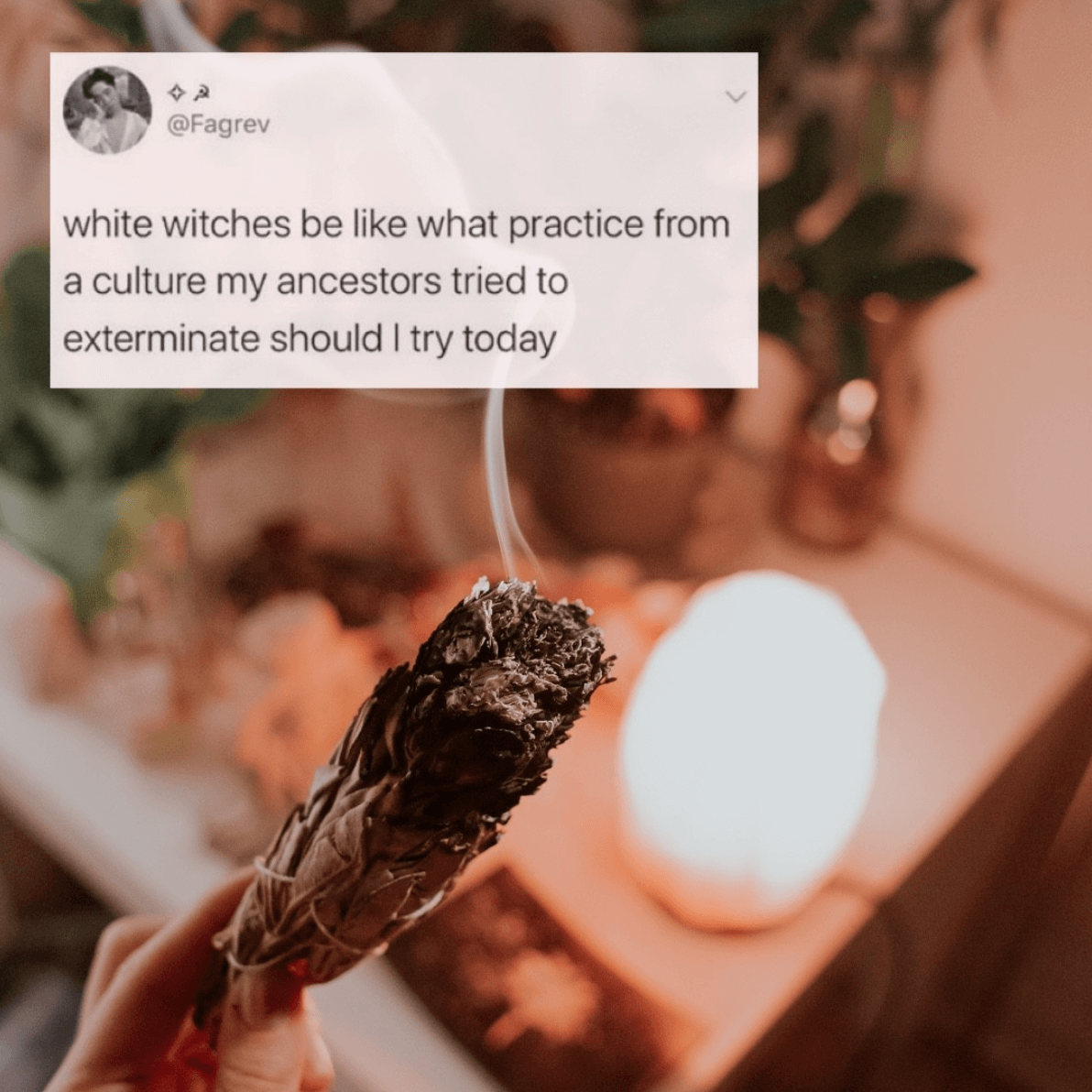
The caption lists eight points to snap white folks out of cultural appropriation and guide them towards doing better.
Point four reads:
"Everyone is Indigenous to somewhere in the world. Touch base with your ancient Celtic/Pagan/European roots."
This idea piques my interest. But I’m a white, middle class, Zimbabwean atheist… What the hell would it look like to touch base with my own roots?
My nervous system is wired to the history and racial tensions of Southern Africa. I have a deep and meaningful soul-connection with bulbuls, weaver birds, loeries, miombo woodlands, imphepho, thunderstorms, and the Cederberg and Nyanga mountains.
Are those my roots?
Well… No matter how I cut it, I am not indigenous in Southern Africa. And the colonial history wrapped up in my ancestors' arrival there has left me woefully disconnected from my region of birth. I speak English. I can now speak French and Spanish (and even some Mandarin), but I can't speak Shona or Ndebele. I can't speak Xhosa or Zulu. I can’t speak Setswana, Bemba or Nyanja. That alone is a chasm.
So who were my ancestors?
They arrived in the 1600s on one of the first ships of Huguenots to set sail from France. They arrived from Ireland. They arrived from Scotland via Liverpool. Having brutalised and traumatised each other until some of them were forced to seek out new lives elsewhere, they went on to spread their trauma throughout the colonies.
In what part of any of that am I supposed to find belonging?
Searching
Around the same time I started having sleepovers at Aura’s house, my aunt took my sister and I to a book shop at West Gate and told us that we could pick anything that took our fancy. After browsing the aisles, I picked up Principles of Wicca by Vivianne Crowley and presented it to my aunt. A flicker of misgiving crossed her face, but after a moment’s hesitation she bought the book for me anyway.
God, as taught to me by assembly hymns, made no sense to me. But if there were anything worth worshipping, Nature would be it. There lay the appeal for me. But that look on my aunt’s face stayed with me. And I still feel a little embarrassed about my interest in Wicca and paganism today.
The book was compelling, but as one sceptical friend put it, “Are you just going to suddenly start believing in pagan gods and goddesses now?” She had a point. A literal approach to the pagan deities didn’t feel authentic to me. And certain aspects of the rituals and spells in Crowley’s book made me uneasy. I had the feeling that someone had (quite recently) made it up as they went along.
I get the same feeling now around New-Agey things - like body-mind charts that state unequivocally that “pain in your hips is linked to betrayal” (although no two body charts ever say the same thing).
Is this what it looks like to culturally appropriate your own culture?
A glimmer
I recently listened to the podcast Witch on BBC Sounds, in which host, India Rakusen, asks, “What does it mean to be a witch today?” Over the thirteen episodes, she explores ancient connections between nature and the idea of magic, dispels misconceptions around the witch hunts, learns more about the science behind spells, and questions the big business of witchcraft today.
I found many parallels to draw between the word “witch” and the practice of yoga. Their complex histories are far from simple to grasp and both are subject to misrepresentation and New Age, neoliberal commodification.
With my wife and friends, I use the term “witch” liberally. I’m fairly convinced that as a queer feminist, I’d have been burnt at the stake. But like India Rakusen, I would hesitate to call myself a witch with any kind of confidence. The word requires a more sensitive approach.
Just as I stand on the edge of Indian culture looking in, I stand on the edge of Gaelic/ Celtic/Pagan culture looking in, and I find myself wondering, “Can I really feel at home in it?”


I don’t have a clear answer, but listening to Rakusen’s podcast has softened my embarrassment and it has even awakened a little childhood wonder that I’d lost along the way. I feel the invitation “to listen to the world beyond the ways we’ve been told we’re allowed to” is necessary in this age of climate catastrophe. Animism - the belief that all aspects of the natural world contain spirits, and that communication is possible with these spirits - is a poetic and potentially healing approach to our place in the living world. The seasonal celebrations of the Wheel of the Year offer practical ways to start connecting with that world. And I’m drawn to the fundamentally feminist figure of the witch and the power to be unlocked in embracing age and becoming a proud hag.
As for spells and rituals, making it up as you go along rather than turning to so-called experts in books or on #WitchTok might actually be the secret to making it less cringe. Kathryn T Hall, an expert on the placebo effect, says, “As long as it doesn’t harm. As long as you’re not a charlatan. Yes! By all means. [..] Get your healing. Make your potion. Make your chant. Make your salve. Make your spell and do it for good.”